
Our Simple Money System for Budgeting, Saving & Investing
| This post may contain affiliate links and referral links. If you click through and make a purchase or sign up, I may earn a small commission at no additional cost to you. I only share products and tools we personally use and genuinely recommend. |
| Disclaimer: I’m not a financial advisor or expert. Everything I share here is based on our own personal experience and what has worked for our family. Please do your own research and consult a financial professional before making any major financial decisions. |
We don’t fight about money.
Considering financial disagreements are one of the most common sources of conflict in relationships, that feels a little unusual to say, but it’s something I’m really proud of.
Now it’s not because my husband and I always agree. TRUST ME! It’s also not because money has never been stressful, and it’s definitely not because we’ve never faced hard financial decisions.
Instead, it’s because we built a system years ago that takes most of the emotion out of managing our money. Instead of making dozens of financial decisions every week, we let our system make most of them for us.
In more than a decade together, I can honestly say we’ve never had a true argument about money.
Have we had conversations? Absolutely. Have we adjusted goals, debated purchases, or changed our minds? Of course. But we’ve never had a fight where money itself was the problem. I don’t think that’s because we’re somehow naturally good with money. I think it’s because our system gives a majority of our dollars a job before they arrive.
In this post, we’ll dive into how we set ourselves up for success. You might find something that works for you, you might not, but if anything – I hope it offers you the ability to learn something new.
If you haven’t already read about our money rules as a couple, I’d highly recommend reviewing them, as these topics go hand in hand.
The Philosophy First
Before I walk you through our accounts, the the tools we use, or where every dollar goes, I think it’s important to explain the philosophy behind all of it. The truth is, our system isn’t built around spreadsheets or bank accounts. It’s built around how we think about money. Our mindset.
We’ve never viewed budgeting as a form of restriction. To us, it’s simply awareness. Our budget isn’t a list of everything we can’t buy. It isn’t meant to make us feel guilty every time we spend money. It’s a tool that shows us where our money is actually going so we can decide whether it reflects the life we’re trying to build. Sometimes it does. Sometimes it doesn’t.
Neither outcome is bad. One gives us confidence, and the other gives us information.
One of the biggest habits that keeps everything running smoothly is giving a majority of our dollars a job before they arrive. By the time a paycheck lands in our checking account, we’ve already decided what a solid chunk of that money is meant to do. Some pays the bills, a lot is invested, and the remaining will go towards expenses, short-term savings, or be spent on things we enjoy.
Because those decisions are made ahead of time, we don’t have to keep making them every week. The system quietly runs in the background, which means we spend less time managing money and more time living our lives. If there’s one thing I’ve learned about wealth, it’s that it’s actually really boring.
The Accounts: How We’re Set Up
One thing people are often surprised by is how simple our banking setup actually is.
There are budgeting systems that require half a dozen checking accounts, multiple cards, cash envelopes, and complicated automations. If that works for someone, that’s great. We’ve just found that simpler is easier to stick with.
Here’s exactly how our money is organized.
Joint Checking Account
Everything starts here. All paychecks are deposited into our joint checking account, and every monthly bill is paid from it. This is the hub of our entire financial system, the ONE account that everything else flows through. We don’t mess around with the whole your bank account, my bank account, let me pay you for this and you pay me for that. TBH that just sounds complicated, and a headache I don’t want to deal with.
We chose to bank with a local credit union instead of a large national bank because we’ve consistently had better customer service, lower fees, and a much more personal experience. If you’re curious why we’re such big fans of credit unions, I shared more about it in my post on our favorite money tools.
High-Yield Savings Account
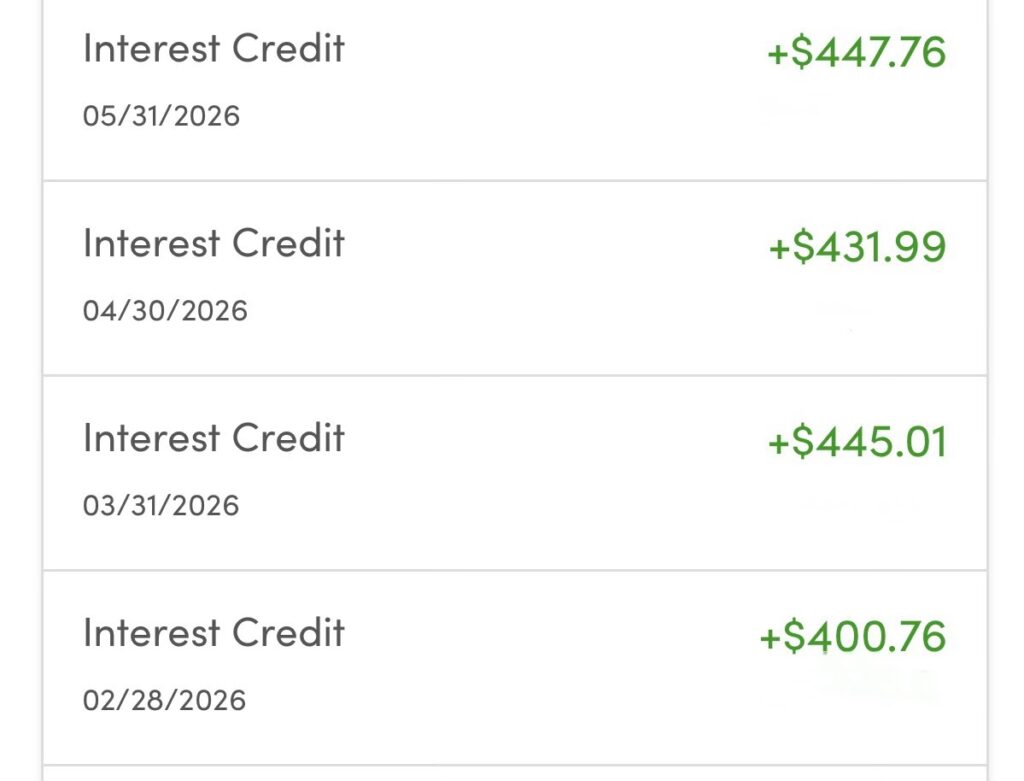
Our high-yield savings account is where we keep both our emergency fund and all of our sinking funds. One of the reasons we love using a HYSA is because our money keeps earning interest while it’s waiting to be spent. Whether we’re saving for a car, Christmas shopping, a vacation, or a future home project, that money isn’t just sitting idle.
When we were preparing to build our home, our down payment and cash funds sat in this account for nearly three years. During that time it continued earning interest while we waited to break ground. It wasn’t life-changing money, but it was money we would’ve missed out on in a traditional savings account.
To us, that’s an easy win.
Investment Accounts
Once money is designated for long-term investing, it moves into our investment accounts. Between our 401(k)s, HSAs, Roth IRAs, and brokerage accounts, we primarily invest through Vanguard and Fidelity.
Our investing philosophy is intentionally simple: invest in broad-market index funds and contribute consistently. That’s it.
One of the biggest reasons we’ve been able to stay consistent over the years is because most of our investing happens automatically. We treat it just like any other monthly bill.
Every paycheck automatically contributes to our 401(k)s, and we make sure our HSA (health-savings account) is fully funded throughout the year. In years when cash flow allows, we also like to fully fund our Roth IRAs near the beginning of the year so that money has as much time as possible to grow. We haven’t done that every single year, but whenever we’re able to, it’s our preference.
By automating as much as possible, we remove the temptation to wonder whether this is the month we’ll invest or wait until the next one. The decision has already been made. We’ve never tried to pick the next winning stock or perfectly time the market. We’d rather trust decades of consistent investing than our ability to predict what the market will do next. It’s not glamorous, but it gets the job done.
Sinking Funds: What We’re Working Toward
If there’s one part of our money system that we’re still improving, it’s our sinking funds.
A sinking fund is simply money you set aside regularly for a future expense that you know is coming. Things like Christmas, vehicle maintenance, home repairs, vacations, or annual insurance premiums aren’t emergencies, they’re expected expenses. A sinking fund helps make sure they don’t feel like surprises when they arrive.
Our long-term goal is to have dedicated sinking funds for things like:
- Vehicle maintenance and future replacement
- Home maintenance and repairs
- Christmas and gifts
- Vacations
- Other irregular expenses throughout the year
If I’m being completely honest, though, we aren’t fully there yet.
Right now, we keep a healthy cash cushion in our high-yield savings account instead of assigning every dollar to a specific sinking fund. We know we have money available for things like Christmas shopping, replacing appliances, or an unexpected home repair, we’re just not tracking each category down to the dollar quite yet.
That approach has worked well for us, especially during seasons like building our home when cash flow has looked a little different than usual. It also creates a healthy balance of structure and flexibility in our financial relationship. I don’t like being so ridged that we feel like we can’t pull money when we want to, and my husband appreciates that flexibility.
At the same time, I also know there’s room for improvement. One of my goals over the next few years is to become more intentional about assigning those dollars to specific purposes before we need them. It’s one of the reasons I included sinking funds inside my , even though I’m not using every category perfectly myself yet.
That’s the thing about personal finance. Your system doesn’t have to be perfect to be working, it just has to be better than it was yesterday.
For us, having a healthy savings buffer has eliminated a lot of financial stress. The next step is simply becoming more intentional about how those dollars are organized.
Credit Cards: A Tool, Not a Trap
Credit cards are probably one of the most misunderstood parts of our money system. We use them for almost every purchase we make, and then we pay the balances in full every single month.
For us, credit cards aren’t a way to spend money we don’t have. They’re simply the payment method we use for money we were already planning to spend. If the money isn’t sitting in our checking account to cover the purchase, it doesn’t go on the card.
That’s our rule.
We also use different cards for different spending categories so we can earn the most cash back on the purchases we’d be making anyway. I share exactly which cards we use and why in my favorite money tools post if you’re curious.
The cash back we earn isn’t life-changing, but over the course of a year it adds up. Instead of applying it toward our statement balance, we usually save those rewards for something fun. A date night, something for the house, or a purchase we didn’t necessarily want to spend our own dollars on. It makes those little extras feel like a bonus rather than something we have to budget for.
That said, I don’t think credit cards are the right tool for everyone. If carrying a balance has been a struggle in the past, I’d focus on building a solid budgeting system before worrying about rewards. Cash back is only valuable if you’re paying your balance in full every month. Otherwise, the interest you’re paying will almost always outweigh anything you earn.
For us, though, credit cards have become another part of a system that’s designed to work quietly in the background.
How We Stay on the Same Page
I think one of the biggest reasons our system works is because we don’t save all of our money conversations for one big meeting. Money is a very normal topic in our house.
We’ll talk about it while we’re making dinner, driving somewhere, planning a vacation, or working on a project around the house. Sometimes it’s a conversation about a purchase we’re thinking about. Other times it’s celebrating that we hit an investing milestone or paid off another debt.
Because we talk about money so often, it never feels like this big, intimidating subject that either of us avoids. At the beginning of each year, we do carve out a little more intentional time together. We’ll update our net worth, look at our savings rate, check in on our investment progress, and talk about what we want our money to accomplish over the next year.
It usually takes less than an hour. But that one conversation helps make sure we’re still pulling in the same direction.
I always talk about how the most important financial decision you make is who you marry, and I’m not kidding. You can have a perfect financial plan, but if you and your partner are rowing in different directions, you’ll never get anywhere. A few conversations about your goals and your futures will go a long way.
Want to Build Your Own System?
If you’ve made it this far, I hope one thing has become clear: you don’t need our exact accounts, our exact budget categories, or our exact investing strategy to build a great money system.
You just need a system that works for you and your life.
The Budget Template I created is the same one we use to organize our spending, track our cash flow, monitor our net worth, and keep an eye on where our money is going each month. It’s simple, flexible, and designed to grow with you as your finances become more complex.
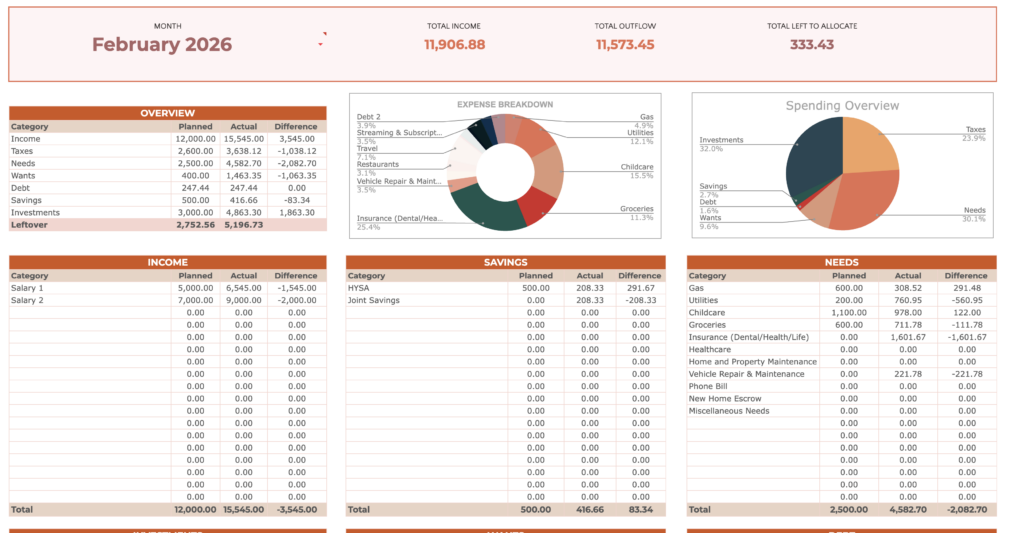
Whether you’re just getting started or looking for a better way to stay organized, my hope is that it gives you something even more valuable than perfectly categorized spending. Awareness. Because when you can clearly see where your money is going, you can start making decisions that align with the life you’re trying to build.
And if you want to track your own path toward financial independence, the FIRE Dashboard is what we use to watch our retirement progress in real time.