
Our 6 Favorite Tools for Building Wealth as a Normal Couple
This post may contain affiliate links and referral links. If you click through and make a purchase or sign up, I may earn a small commission at no additional cost to you. I only share products and tools we personally use and genuinely recommend.
| Disclaimer: I’m not a financial advisor or expert. Everything I share here is based on our own personal experience and what has worked for our family. Please do your own research and consult a financial professional before making any major financial decisions. |
Anytime I talk about our personal finances or how we paid off our first home, bought land, and built our forever home — the first question is usually some version of: what’s your system?
I love this question because the answer is honestly much simpler than you think.
We don’t use an app we have to pay for, we don’t have a complicated spreadsheet with seventeen tabs. However, we do have a small handful of tools that we’ve been using consistently for years, and that consistency is what made the difference.
Here’s exactly what’s in our money toolkit — what each thing is, why we use it, and how it fits into the bigger picture.
1. A Checking Account
This is where everything starts. Now I know what you’re thinking. “Duh, Amber, of course you have a checking account, don’t we all?” Yes, yes we do, but it’s not necessarily about the checking account and more so how we use it. All of our income goes into one joint checking account. one place, all the money, no confusion or question about whose is whose. This is actually one of our core money rules as a couple.
If you want to read more about how we think about shared finances and the other rules behind our debt payoff, I wrote about all of it here: Steal My Proven Money Rules as an Everyday Working Mom Who Finds Joy in the Little Things.
We specifically prefer a credit union over a traditional big bank, and here’s why: credit unions are member-owned, which typically means lower fees, better customer service, and rates that actually work in your favor. They’re not trying to make money off of you the way a big bank is. But also, a checking account is a checking account so bank wherever is most convenient for you. We like our local credit union, but you don’t need anything fancy here. You just need one reliable account that your income direct deposits into and your bills flow out of. The simpler this piece is, the easier everything else becomes.
What to look for in a checking account:
- No monthly fees
- ATM reimbursements or a large ATM network
- Easy online access and a solid mobile app
- Good customer service
2. A High Yield Savings Account (HYSA)
If your savings are sitting in a traditional savings account earning 0.01% interest, I need you to read this section carefully because this is one of my greatest financial mistakes of all time. For years, I would let my money just sit. I’d earn cash or get it for gifts and hoard it coffee can style where it was doing literally NOTHING for me. Learn from me, and don’t make this mistake.
A high yield savings account (HYSA) is exactly what it sounds like — a savings account that pays you significantly more interest on your money. While traditional savings accounts at big banks were offering essentially nothing for years, HYSAs have been paying rates that actually make a meaningful difference over time.
We use CIT Bank for ours. It’s where our emergency fund and all other short term savings live. Anytime we’re intentionally setting aside money for things like home repairs, vehicles, vacations, and irregular expenses, it’s transferred to our HYSA. While that money is sitting and waiting to be used, it’s earning interest. That’s money we didn’t have to do anything for.
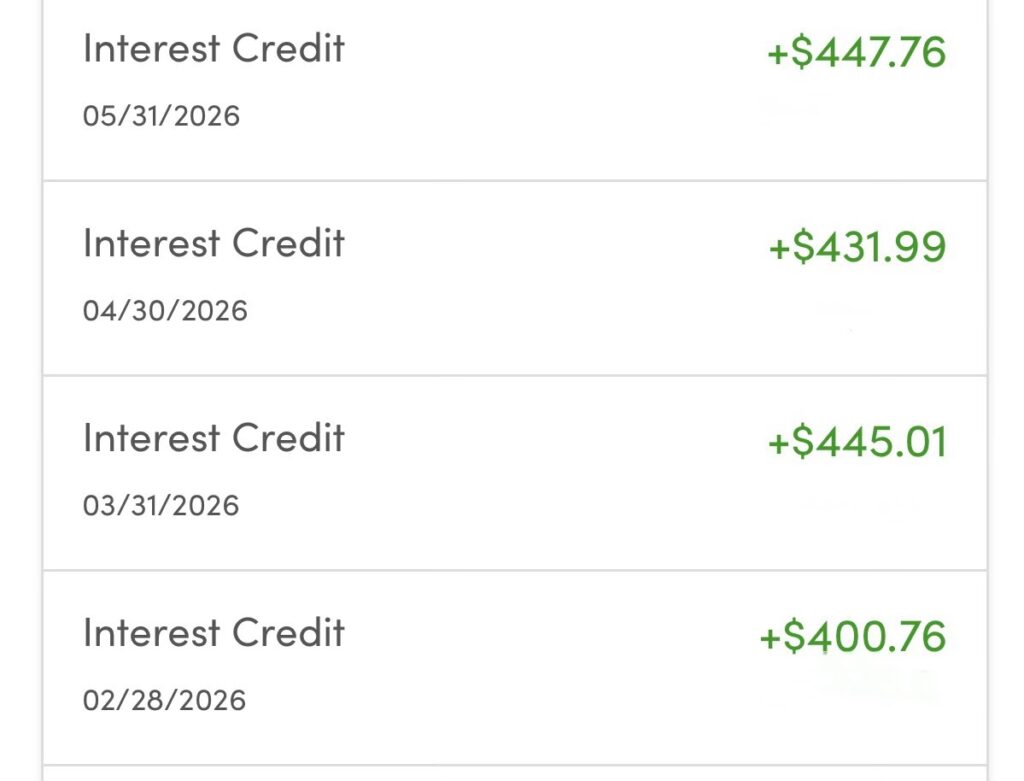
When we were saving for our forever home build, we transferred money to our HYSA on a regular basis, and our down payment money sat in a HYSA earning interest that entire time. Just to show you what’s possible, this is what we were earning on a monthly basis. I’m telling you, it’s worth it.
What a HYSA is good for:
- Emergency fund (3-6 months of expenses)
- Sinking funds: saving up for specific future expenses
- Short-term savings goals (anything you plan to use within 1-3 years)
- Any money you want to keep liquid but still working for you
It’s not for long-term investing, that’s what our investing tools are for. But for your accessible savings? A HYSA is non-negotiable in our house.
3. Credit Cards — Paid in Full Every Month
Another one of our money rules as a couple. All spending goes on a credit card, no if, ands, or buts about it. If I’m being honest, I couldn’t even tell you where my debit card is.
Also worth knowing — credit cards are actually safer than debit cards for everyday spending. When fraud happens on a debit card, that’s real money pulled directly from your bank account while you wait for the dispute to resolve. With a credit card, you’re disputing a charge on money that hasn’t left your account yet. The liability protection is significantly stronger, and most major cards offer zero fraud liability. One more reason to ditch the debit card.
We use credit cards for almost everything. Groceries, gas, restaurants, online shopping — if the merchant takes a credit card with no additional fees, it goes on a credit card. But here is the rule we never break: we pay them off in full every single month. There is no way we’re handing over our hard-earned dollars to interest on a credit card.
Now, I want to be real for a second — I understand that things happen. Credit card debt is something a lot of people are carrying right now, and it can be a vicious cycle that’s genuinely hard to break out of. If that’s where you are, I’m not here to make you feel bad about it. But I’d be doing you a disservice if I didn’t say this: if you’re currently in credit card debt, I’d recommend holding off on the credit card strategy until you’re in a place where you can pay the balance in full every month. The rewards are not worth the interest. Not even close. Get to zero first, then use the card as a tool.
When you use credit cards this way, they stop being a debt trap and start being a tool that quietly earns you money while you spend money you were going to spend anyway.
Here’s our actual card setup:
- Amex Blue Cash Everyday — Earns us higher cash back in areas we frequently spend like groceries, streaming services, and online retail
- Citi Double Cash — This is our everyday catch-all for anything that doesn’t fall into a higher category, we earn 2% back on all purchases.
- Costco Citi Card — If you have a Costco membership, the credit card is a no brainer. 4% cash back on gas, 3% back on restaurants, and of course rewards on your Costco purchases.
- Discover It Card: TBH we rarely use this card. It was the first credit card I ever opened when I was 18, and we kept it specifically for the Q4 cash back rotation: 5% back at Amazon, Walmart, and Target right when we’re doing our Christmas shopping. That alone is worth it.
- Chase Sapphire Preferred : We’re new to the travel hacking game, but we’ve done a ton of research and this card is what will give us the best ROI for traveling with our family.
I know what you might be thinking, it’s a lot to keep track of. But here’s the thing: it’s really not complicated once you just know what each card offers and where it earns best. You don’t have to think about it after the initial setup. You just know that groceries go on the Amex, gas goes on the Costco card, and everything else goes on the Citi Double Cash. It becomes automatic. Not all cards are used all the time.
If I Had to Choose TWO
All that said, you genuinely don’t need all of them. If I had to simplify it down to two cards, here’s what I’d pick: one card in a high-earning category you consistently spend in (for us that’s groceries, so the Amex makes sense), and then a Citi Double Cash as your everyday card, because that flat 2% cash back on everything is one of the best no-fuss rewards rates out there.
We’re not your usual travel hackers. We use our cash back for guilt-free purchases in real life. A mirror for the new house, a rug, beauty products, kids’ back to school items. Things we were going to buy anyway, essentially paid for by rewards we earned on our regular spending.
The only rule: if you can’t pay it off at the end of the month, don’t put it on the card. End of story.
4. Rakuten — The Easiest Cash Back You’ll Ever Earn
If you’re not using Rakuten, you’re leaving money on the table. I mean that literally.
Rakuten is a cash back browser extension and app that gives you a percentage back on purchases you make at thousands of online retailers — Target, Amazon, Walmart, Gap, and hundreds more. You shop like you normally would. Rakuten tracks it and sends you a check (or PayPal payment) every quarter.
It takes less than five minutes to set up. You install the browser extension, create an account, and it automatically activates cash back when you’re on a qualifying retailer’s site. That’s it. You don’t have to think about it.
We stack Rakuten on top of our credit card cash back whenever we can — so we’re earning rewards from the card AND a percentage back from Rakuten on the same purchase. It adds up more than you’d expect over a year.
Earn $50 for signing up, and making your first purchase in the first 90 days.
5. Vanguard + Fidelity — Where the Long-Term Money Lives
I want to be upfront: I am not a financial advisor and I’m not going to tell you exactly what to invest in. What I can tell you is what we do and why it works for us.
The bulk of our investing is through Vanguard and Fidelity. Our 401Ks, our ROTH IRAs, and our personal brokerage accounts all live in one of these two places. We max our 401Ks every year. We max our HSA, and keep our out of pocket maximum lucrative, while investing any remaining dollars. Most importantly, we invest consistently — not when the market feels right, not when we have extra money, but on a regular schedule because time in the market beats timing the market every single time. If I’m being honest, I’m not paying attention to the market most of the time. Couldn’t tell you if it’s up or down today, but what I can tell you is that I got paid yesterday and I invested a portion of my paycheck to my 401k.
We recently hit the income limit for Roth IRA contributions, which is a GOOD problem to have, but a problem we’re navigating our options and exploring, the backdoor Roth method. If you’re not at that income threshold yet, a Roth IRA is one of the most powerful tools available to you and I’d encourage you to look into it.
The biggest investing lesson I’d pass on: start earlier than you think you need to. I opened my first retirement account in my early twenties, all on my own, with no one walking me through it. I wish I had contributed more back then. But I’m so glad I started. My husband started even earlier than I did and you can see the difference that time makes when you look at our accounts side by side.
Something is genuinely better than nothing. The earlier you start, the more time your money has to grow.
6. Our Budget Template — The Tool That Ties Everything Together
When you understand where your money is going, you can intentionally direct it toward the life you want to build.
I want to be honest with you here, because I think this is important.
We didn’t start formally tracking every dollar until the last few years. For most of our debt payoff journey, we weren’t obsessively logging every purchase into a spreadsheet. What we were doing was staying aware, spending intentionally, and making decisions that aligned with what we were building toward. And that alone got us really, really far.
I don’t think tracking your spending is a requirement for building wealth, but what I will tell you is this: when we did start tracking everything, it changed how we looked at our money in a way I didn’t expect. When you can see exactly where every dollar is going, you make different decisions. Not because you’re restricting yourself, but because awareness does something to your brain. You start to notice the things that don’t actually matter to you. You start to redirect money toward the things that do.
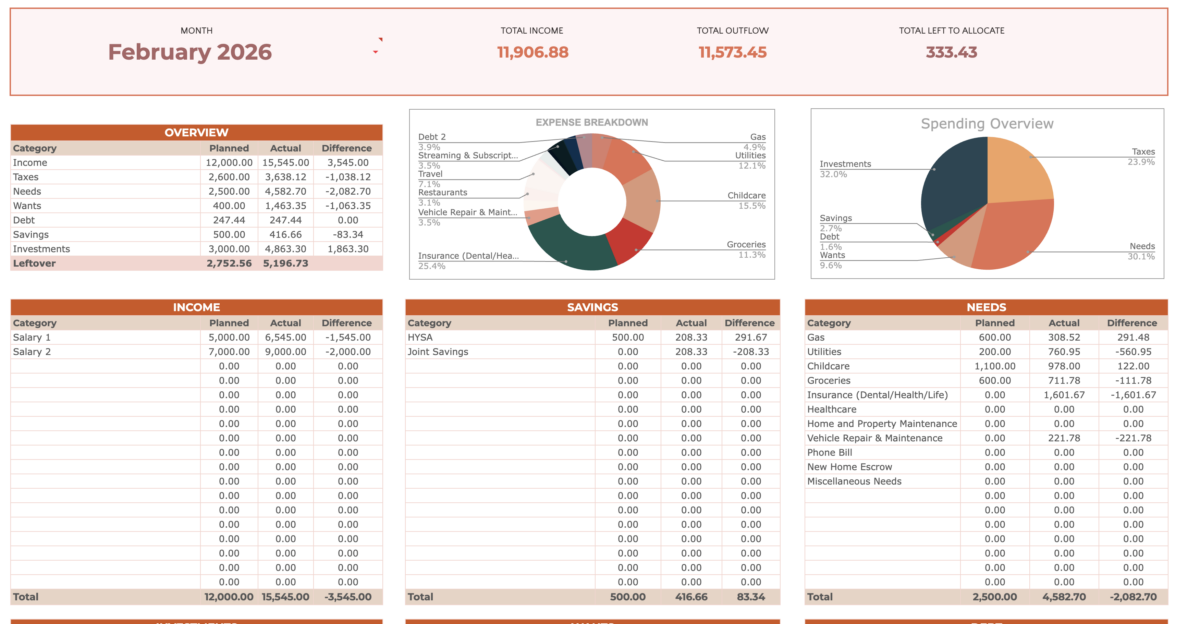
That’s what our Budget Template is built for. Not to restrict your spending, but to make it visible. It’s where we track spending categories, sinking funds, and net worth. It’s the hub that connects every other tool on this list. And if you’re ready to start paying attention to where your money is actually going, it’s the simplest way I know to do that.
We track our net worth once a year at the beginning of the year — assets minus liabilities, that’s it. It’s not complicated. Your net worth is simply everything you own minus everything you owe. Tracking it annually gives you a clear picture of whether you’re moving in the right direction, and seeing that number grow year over year is one of the most motivating things you can do for your financial mindset.
The Takeaway
You don’t need a complicated system. You don’t need a dozen apps. You need a few reliable tools, the discipline to use them consistently, and the patience to let them work over time.
Other Posts You May Find Interesting
Steal My Proven Money Rules as an Everyday Working Mom Who Finds Joy in the Little Things