
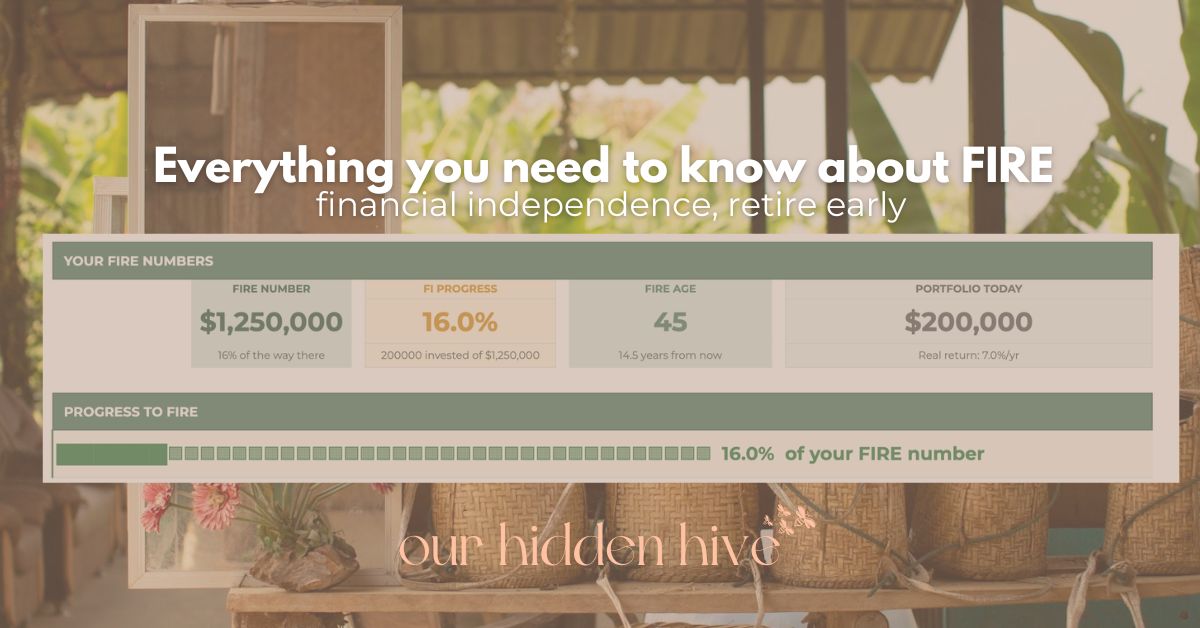
What Is FIRE? Everything You Need to Know About Financial Independence
| This post may contain affiliate links and referral links. If you click through and make a purchase or sign up, I may earn a small commission at no additional cost to you. I only share products and tools we personally use and genuinely recommend. |
| Disclaimer: I’m not a financial advisor or expert. Everything I share here is based on our own personal experience and what has worked for our family. Please do your own research and consult a financial professional before making any major financial decisions. |
What Is FIRE? (and why I think it’s so misunderstood)
When I first heard about FIRE, I assumed it was for people who wanted to retire at 35, sell everything they owned, travel the world in a van, or spend the rest of their lives lounging on a beach somewhere.
That version of retirement never really appealed to me.
The more I learned, though, the more I realized I’d completely misunderstood what FIRE actually is.
FIRE stands for Financial Independence, Retire Early, but I think the “retire early” part gets all the attention when the real goal is financial independence.
At its core, FIRE is about building enough wealth that your investments could support your lifestyle if they ever needed to. It doesn’t mean you have to stop working. It doesn’t mean you have to retire at 40. And it definitely doesn’t mean everyone pursuing FIRE has the exact same dream.
That’s actually one of my favorite things about it. Like most of personal finance, it’s personal.
Financial independence looks different for everyone. For some people, it’s traveling the world. For others, it’s leaving a stressful job, starting a business, working part-time, spending more time with family, or simply knowing that if life threw them a curveball, they’d have options.
To me, that’s what makes FIRE so compelling. It’s less about retiring early and more about creating the freedom to choose what you want your life to look like.
The Math Behind FIRE: Finding Your Number
Before we talk about the different types of FIRE, it helps to understand two simple concepts: your FIRE number and the 4% rule.
Your FIRE number is the amount of money you’d need invested to become financially independent. In other words, it’s the point where your investments could reasonably support your lifestyle if they ever needed to.
The math is surprisingly simple:
FIRE Number = Annual Expenses × 25
Let’s say your family spends about $50,000 per year. Your FIRE number would be $1.25 million.
If your annual expenses are closer to $80,000, your FIRE number would be about $2 million.
So where does that number come from?
It comes from what’s commonly known as the 4% rule. Based on historical market research, the idea is that someone with a well-diversified investment portfolio could withdraw approximately 4% of their portfolio each year, adjusted for inflation, and have a high likelihood of their money lasting at least 30 years. It’s not a guarantee, markets don’t come with guarantee, but it’s become one of the most widely used planning guidelines in the FIRE community.
If you’re wondering why the math works, it’s simply because multiplying your annual expenses by 25 is the same as dividing them by 0.04.
Different equation. Same answer.
The important thing isn’t memorizing the formula, it’s understanding what it represents. Your FIRE number isn’t a goal someone else gives you. It’s based entirely on your lifestyle, your spending, and the life you want to build. Someone who dreams of traveling the world will likely need a very different number than someone who hopes to spend more time gardening, volunteering, or working part-time close to home.
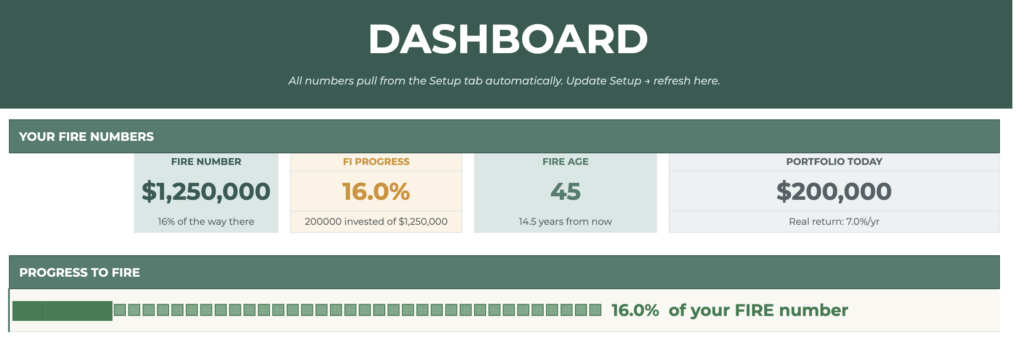
If math isn’t your favorite thing (or you’d rather skip the calculator), I created a FIRE Dashboard that does all of this for you. Just enter your current investments, contributions, and spending, and it will estimate your FIRE number, show your progress, and help you visualize different retirement timelines, including Coast FIRE and Barista FIRE scenarios.
The Different Types of FIRE
This is where FIRE gets really interesting, and where I think a lot of people realize there isn’t just one path to financial independence.
Depending on the lifestyle you want, the amount you spend, and what you hope retirement actually looks like, there are several different versions of FIRE. None of them are inherently better than another. They’re simply different ways of designing a life that aligns with your goals.
Lean FIRE
Financial independence on a smaller budget
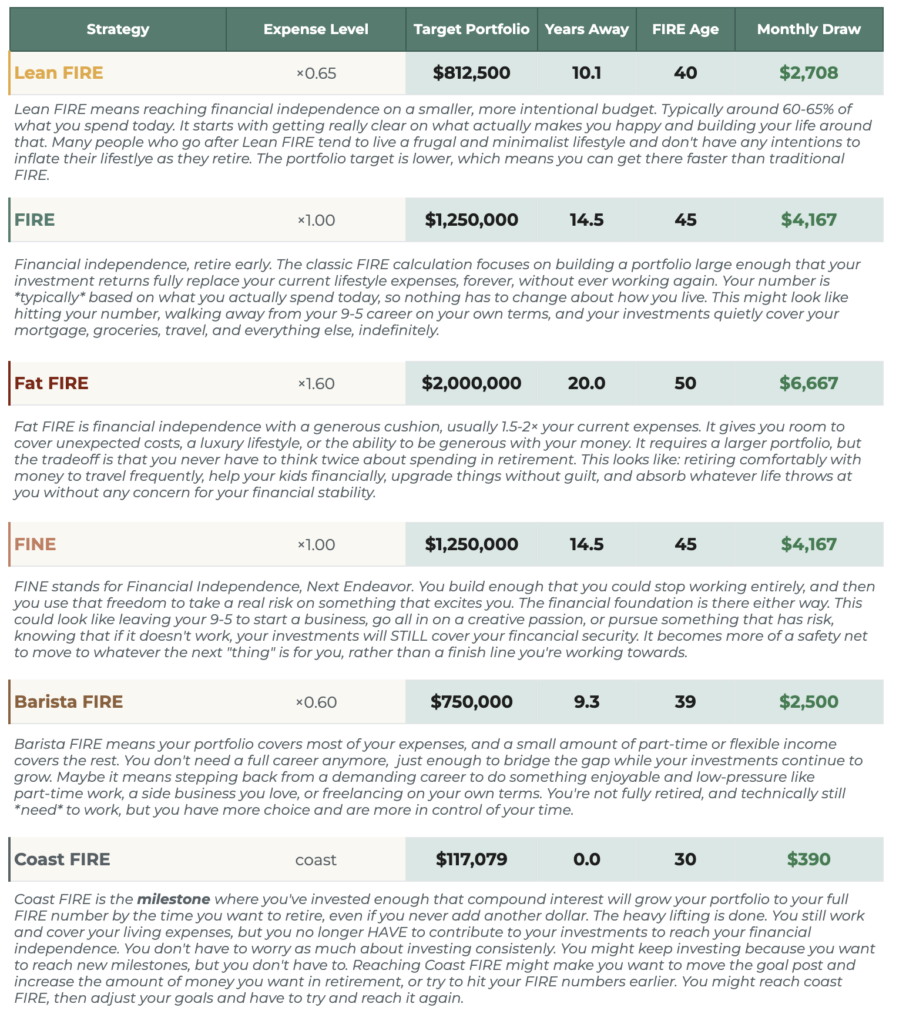
Lean FIRE is exactly what it sounds like. You reach financial independence by intentionally living on less, typically around 60–65% of what you spend today. That means you need a smaller investment portfolio, which often allows you to reach financial independence earlier.
People pursuing Lean FIRE usually value simplicity over luxury. They aren’t sacrificing to get there; they’ve intentionally built a life around the things that make them happiest and don’t feel the need to spend more just because they can.
The trade-off is that there’s less room for unexpected expenses or lifestyle inflation, so it works best for people who genuinely enjoy living simply.
Traditional FIRE
Financial independence with your current lifestyle
When most people talk about FIRE, this is what they’re referring to.
Traditional FIRE means building a portfolio large enough that your investments could replace your current annual expenses. If you reached your FIRE number tomorrow, you could theoretically stop working and continue living basically the same way you do today.
For many people, this looks like leaving a traditional 9-to-5 career on their own terms while knowing their investments are covering the bills behind the scenes.
Fat FIRE
Financial independence with some extra cushion
Fat FIRE follows the same concept as traditional FIRE but with a much larger financial cushion, often around 1.5 to 2 times your current spending.
The goal isn’t just to simply to cover your expenses. It’s to create enough margin that you can travel more, spend more generously, help family, upgrade your lifestyle if you choose, and absorb unexpected costs without worrying about your finances. Basically you’re ballin’, but still on a budget.
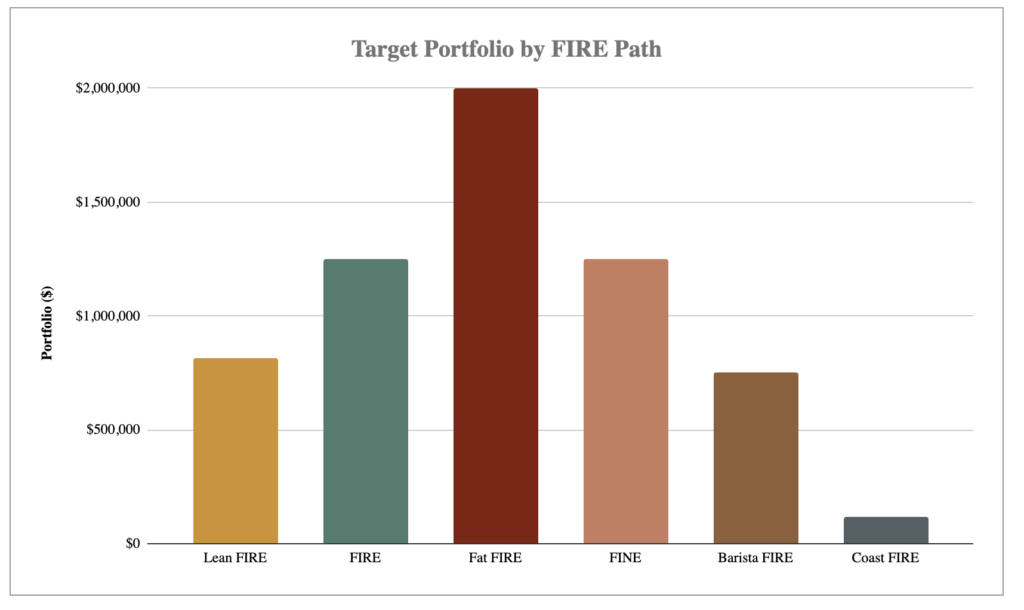
Because the portfolio is significantly larger, it usually takes longer to reach. The payoff is more flexibility and financial breathing room once you get there.
FINE
Financial Independence, Next Endeavor
This is one of my favorite versions because it reframes retirement entirely. Instead of asking, “When can I stop working?” FINE asks, “What would I do if work became optional?”
Maybe you leave your corporate job to start a business. Maybe you finally write the book you’ve always wanted to write. Maybe you volunteer, teach, create, or pursue a passion that doesn’t necessarily pay the bills. Heck, maybe you work at Kwik Trip!
Your investments provide the financial foundation, giving you the confidence to take a meaningful risk because your security doesn’t depend on whether it works out for you.
Barista FIRE
Working because you want to, not because you have to
Barista FIRE is often considered the middle ground between working full-time and fully retiring.
Your investment portfolio covers most of your expenses, while a small amount of flexible income fills the gap. That might mean working part-time, freelancing, running a small business, or taking a lower-stress job simply because you enjoy it.
The goal isn’t to stop working completely. It’s to remove the pressure of needing a full-time career to support your lifestyle. For a lot of people, this offers the best of both worlds: meaningful work, plenty of flexibility, and continued investment growth.
Coast FIRE
Do the hard work early, then let time take over
This is the version that completely changed the way I think about retirement. Coast FIRE isn’t actually a retirement strategy, but it’s a milestone.
It means you’ve invested enough early in life that, even if you never contributed another dollar toward retirement, compound growth alone should grow your portfolio to your full FIRE number by the time you plan to retire.
You still work. You still cover your everyday living expenses. But the pressure to aggressively save for retirement starts to fade because you’ve already done the heavy lifting.
For me, Coast FIRE represents something bigger than a number. It’s proof that your younger self made decisions your future self will be grateful for.
It’s worth noting that your path to Coast FIRE could change. As your life changes, your goals might change too. Some people reach Coast FIRE based on their original FIRE number and then decide they actually want to pursue Fat FIRE or retire even earlier. In that case, they’ll continue investing because they’ve moved the goalpost. There’s nothing wrong with that. Your financial plan should evolve right alongside your life, and your FIRE goal can evolve too.
Which one is right for you?
The beauty of FIRE is that there isn’t a RIGHT answer. Some people dream of Lean FIRE because they genuinely love living simply. Others are working toward Fat FIRE because they want a larger financial cushion. Many people discover that Barista FIRE or Coast FIRE feels far more realistic than retiring decades early.
The best version of FIRE isn’t the one that gets you retired the fastest. It’s the one that helps you build the life you’ve been after all along.
Is FIRE only for high earners?
This is probably the biggest criticism of FIRE, and honestly, I understand where it comes from.
There’s no question that a higher income makes the math easier. The more money you earn, the more you have the potential to save and invest each month. I’m not going to pretend otherwise. But I also think sometimes people assume that if they can’t retire at 40, FIRE isn’t worth pursuing at all. That’s where I disagree.
At its core, FIRE isn’t really about having a high income. It’s about creating a gap between what you earn and what you spend, then consistently investing that gap over a long period of time. The size of that gap, and how quickly it grows, will look different for everyone.
For our family, the biggest difference wasn’t one massive paycheck. It was a series of intentional decisions repeated over and over again. The focus on increasing our income when we had the opportunity to do so. We choose to avoid consumer debt, resist lifestyle inflation as our income grows, invested consistently, and keep our long-term goals in front of us.
Even if you never retire decades early, moving in the direction of financial independence is still worth it. Maybe you reach Coast FIRE in your thirties or forties. Maybe you build enough investments to take a lower-paying job you love, start a business, or weather an unexpected layoff with confidence.
Financial independence isn’t valuable because it guarantees an early retirement. It’s valuable because it gives you more choices. In my opinion, that’s something worth working toward at almost any income level.
So, what are MY FIRE goals?
After learning about the different types of FIRE, you might be wondering which one we’re actually working toward. Right now, our focus is on Coast FIRE.
We’re not there quite yet, but if we continue investing the way we are today, we expect to reach that milestone in less than a year (we’re currently in July 2026 as I write this). That feels both exciting and surreal because it’s something we’ve been quietly working toward for years without really realizing it.
Even after we reach Coast FIRE, we don’t plan to stop investing. Today, we’re investing around $60,000 each year between maxing out all our retirement accounts, and our long-term goal has always been to make work optional around age 50. That number hasn’t really changed, but what it means to us has started to.
As we’ve gotten older, my husband and I have found ourselves having more conversations about what financial independence might actually look like. Maybe one of us leaves a traditional job to build a business while the other keeps the stability of a W-2. Maybe we both continue working because we genuinely enjoy what we do, just with a lot more flexibility. Maybe our goals change completely. Honestly, we don’t really know yet, and I think that’s okay.
One of the biggest lessons this journey has taught me is that you don’t have to have every detail figured out from the beginning. You don’t need a perfectly mapped-out retirement plan at 32 to start investing at 22, or 32, or 42, for that matter.
You just have to keep making the next good decision. Invest consistently. Avoid lifestyle creep. Build financial margin. Give compound interest time to do its thing.
Then, when life changes, which it will, you’ll have something incredibly valuable: The ability to choose.
To me, that’s the real goal. Options.
Financial independence isn’t about escaping work. It’s about creating enough flexibility that when opportunities come along, you’re able to say yes. Whether that’s starting a business, taking a lower-paying job you love, working part-time, spending more time with family, or retiring early altogether, you’ll have the freedom to make that decision on your own terms.
Ready to see what’s possible?
One of the things I love most about the FIRE movement is that it takes a goal that can feel decades away and turns it into something tangible. Instead of wondering if you’ll ever have enough to retire, or simply have more flexibility, you can start measuring your progress one step at a time.
That’s exactly why I built my FIRE Dashboard.
It’s the same Google Sheet our family uses to track our own progress. It calculates your personalized FIRE number, estimates your retirement timeline, compares the different FIRE paths, including Lean FIRE, Traditional FIRE, Fat FIRE, Coast FIRE, Barista FIRE, and FINE, and helps you visualize how the decisions you’re making today could shape your future.
Whether your dream is retiring at 45, working part-time in your fifties, starting a business someday, or simply building more financial security for your family, I hope this dashboard helps make that goal feel a little more real.
Because financial independence isn’t about reaching someone else’s version of success. It’s about creating the freedom to build your own.
Other posts you may like
Our 6 Favorite Tools for Building Wealth as a Normal Couple
Steal My Proven Money Rules as an Everyday Working Mom Who Finds Joy in the Little Things